The Fed Is Raising Rates Into a Tech Selloff. That Hasn't Happened in a While.
Updated November 6 with the November 5 close and the October jobs report.
Most corrections of the last decade came with a Fed that was cutting, or about to. This one doesn't. That's the single biggest difference between November 2026 and the dips investors are used to buying.
Where policy stands
- September 16: the Fed raised rates, its first hike since July 2023.
- October 28: it held at 3.75–4.00% on a 10–2 vote. The two dissenters, Cook and Hammack, wanted another hike. The statement called growth "strong" and inflation "elevated" (statement via investingLive).
- December 9 odds: futures priced about an 85% chance of a hike after the meeting. That dipped to roughly 70–75% during the October 30–November 2 selloff and was back near 81–82% by November 4–5.
The Bank of Canada (to 2.50%) and the Bank of England (to 4.00%, on November 5) both hiked too. This is a global tightening turn, not a US quirk.
Why they're hiking
| Data | Latest |
|---|---|
| Q3 GDP (advance) | +3.4% annualized (BEA) |
| ISM manufacturing, Oct | 55.5 |
| CPI, Sep | about 3.7% year on year, energy-driven |
| WTI oil, Oct 19 peak | about $110 (Iran war) |
Inflation running near 4% with an economy growing above 3% is a straightforward case for tighter policy, whatever it does to tech multiples.
The bond market isn't fully on board
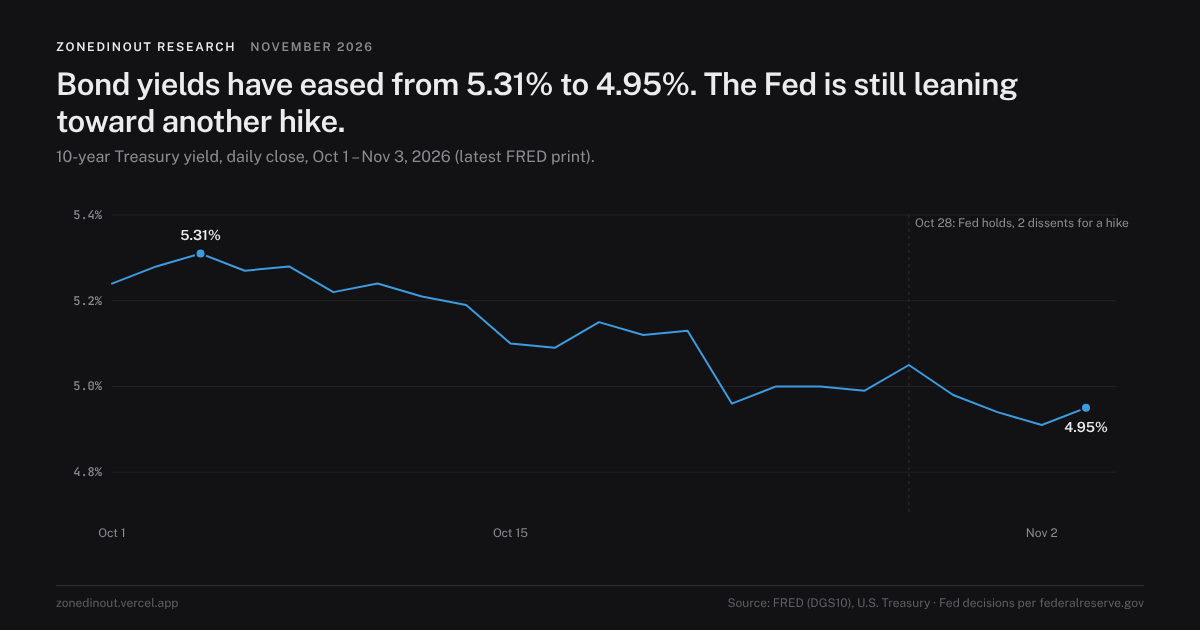
The 10-year Treasury yield closed at 5.31% on October 5, the high of the window. By November 3 it was 4.95%, and our snapshot had it at 4.84% on November 5 (FRED DGS10). The gap between 2- and 10-year yields narrowed from about +47 to +32 basis points.
Long yields falling while the Fed leans toward a hike usually means the bond market expects slower growth ahead. The jobs data now argues against that: October payrolls rose 165,000, far above the roughly 60,000 expected, unemployment fell to 4.1%, and average hourly earnings rose 0.4% on the month and 3.1% on the year (CNBC, BLS). September was revised up from 29,000 to 60,000.
The calm gauge: credit
High-yield credit spreads are the market's stress meter. They went from 3.03% on October 6 to a peak of 3.44% on October 30, then eased to 3.32% on November 4 (FRED). That's wider than August's ~2.70%, but well below the 5%+ levels seen in recession-driven bear markets. The stress is concentrated in specific AI borrowers (see CoreWeave), not spread across corporate America.
Volatility is the gauge that moved most. The VIX closed at 21.15 on November 2 and 16.61 on November 4, then jumped to 28.18 on November 5, the day the S&P 500 fell 4.36%. Credit barely reacted: the junk-bond ETFs JNK and HYG fell only about 0.3% that day.
Why this matters for dip-buying
The last decade trained investors to expect the Fed to step in when stocks fell. A Fed that is hiking removes that cushion. In the YCharts data cited by the Motley Fool, the three times in a decade the Nasdaq was still lower a year after a 5%+ monthly drop were September 2021, January 2022 and April 2022, when the Fed was starting to tighten (Motley Fool). That's three cases, not a law. It is the closest match in recent history to today's setup.
Dates that matter
- Nov 6 (done): October jobs +165,000, unemployment 4.1%, wages +3.1% y/y. Strong hiring and firmer wages give the hawks more reason to hike on December 9.
- Nov 10: October CPI.
- Nov 17: Nvidia earnings.
- Dec 9: Fed decision.
Our macro banner on the Rankings page watches curve inversion, VIX above 25 and junk-bond selloffs. As of the November 5 close one of the three has fired: the VIX at 28.2. The curve is still positive and junk bonds are holding up.
Data: FRED, BEA, Fed statement and linked coverage. Not investment advice.
Scores in this piece come from the ZonedInOut model. How the score works →
Frequently asked
Is the Fed raising rates in 2026?
What is the 10-year Treasury yield in November 2026?
Are credit spreads signaling a recession?
Get the Sunday Brief
One email a week, before the open: what the board did, which calls worked, which didn't, and what changed. Free. No spam, unsubscribe anytime.