AI Demand Is Fine. The Money Behind It Is the Problem the Market Is Now Pricing.
Updated November 6 with the November 5 close and the October jobs report.
Google Cloud grew 103%. Azure grew 48%. AWS grew 39%. And the stocks that sell into that boom just had one of their worst months on record. Here's why that isn't a contradiction.
The cash went negative
In Q3 2026 three of the four largest AI spenders reported negative free cash flow, meaning they spent more on data centers than their businesses brought in:
| Company | What it reported | Market reaction |
|---|---|---|
| Alphabet | First revenue and EPS miss in about four years; free cash flow −$9.07B; capex to "increase significantly in 2027" | Fell about 12–13% on Oct 29, its worst day on record (CNBC) |
| Amazon | 2026 capex about $220B, 2027 "meaningfully more"; trailing free cash flow −$42.4B | Fell after hours, recovered, then rose about 6% on Nov 4 |
| Meta | Raised low end of capex range to $135–145B; free cash flow turned negative | Lower (CNBC) |
| Microsoft | Azure +48%; capex plan trimmed because outside capacity slipped into 2027 | Still free-cash-flow positive |
Put together, the big four are on track to spend roughly $725 billion this year. Investors stopped asking "is demand real?" and started asking "who pays for all this, and with what?"
The money is moving to weaker hands
When the richest companies stop paying cash, the buildout gets financed elsewhere, and that's where the stress shows:
- CoreWeave's five-year credit default swaps crossed 1,000 basis points in mid-October, the level S&P Global treats as distress, and were about 1,140 on November 4. Its 2031 bonds yielded about 15.8% against more than $51B of debt and obligations (CNBC).
- Oracle announced a $10B stock sale plus $10B of bonds to fund AI capex on November 2 and fell about 8%. Deutsche Bank has warned about its BBB rating.
- Forbes reported that nearly half of 2026 data-center bonds are junk-rated (Forbes).
A valuation problem stays in the stock market. A financing problem can spread into credit. That's why this selloff hit the suppliers harder than the spenders.
What it looks like in our data
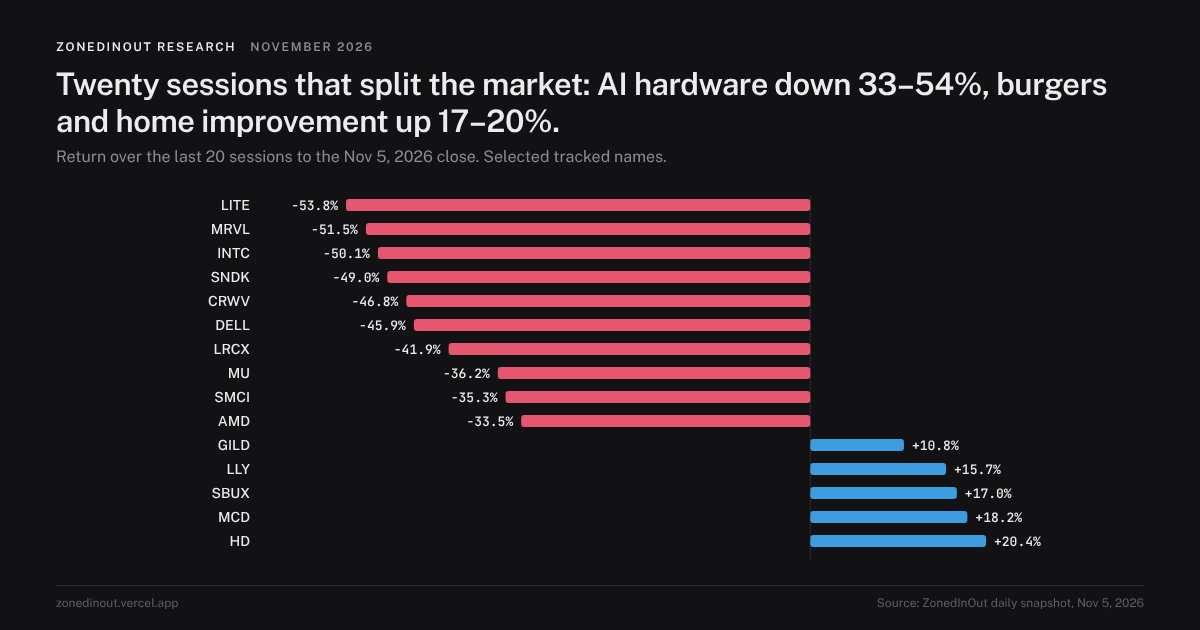
20-session returns to the November 5 close, from our snapshot:
| AI hardware & infrastructure | 20 sessions | Main Street | 20 sessions | |
|---|---|---|---|---|
| Lumentum | −53.8% | Home Depot | +20.4% | |
| Marvell | −51.5% | McDonald's | +18.2% | |
| Intel | −50.1% | Starbucks | +17.0% | |
| SanDisk | −49.0% | Eli Lilly | +15.7% | |
| CoreWeave | −46.8% | Gilead | +10.9% | |
| Dell | −45.9% | |||
| Micron | −36.2% | |||
| AMD | −33.5% |
Intel's −28.6% day on October 30 was its worst since 1974, after it guided Q4 revenue about 9% below expectations. Then on November 5 the Philadelphia semiconductor index fell more than 12% in one session: Micron −17.5%, AMD −17.3%, Nvidia −9.3%. Coverage tied it to what the Democratic sweep means for data-center development (NBC, CNBC).
The part few people are talking about: politics
After Democrats won both chambers of Congress on November 3, Texas's governor-elect pledged a data-center moratorium. On November 4, the companies that build and power data centers fell hard: Hut 8 −23%, Sterling Infrastructure −21%, Comfort Systems −17%, Vistra −13% (CNBC). The same day, the companies that buy AI (Amazon, Microsoft, Apple) went up. The market is starting to separate who spends from who gets paid.
What to watch
- Nvidia's earnings on November 17. Its guidance is the clearest read on whether 2027 orders hold. The stock closed November 5 at $181.60, about 24% below its 52-week high.
- Any hyperscaler trimming 2027 capex. Good for their own cash flow, bad for every supplier on the list above.
- CoreWeave and Oracle credit. If those spreads keep widening and high-yield spreads overall move above about 4%, this stops being an AI story.
We've added Nebius, IREN, Comfort Systems and other movers from this selloff to our tracked list so their scores show up on the board.
Not investment advice. Company figures are from Q3 2026 reports as covered by the linked sources.
Scores in this piece come from the ZonedInOut model. How the score works →
Frequently asked
Why are AI stocks falling in November 2026?
Why did Intel stock drop 28% on October 30, 2026?
Why did Alphabet stock fall after earnings in October 2026?
What is CoreWeave's credit risk?
Get the Sunday Brief
One email a week, before the open: what the board did, which calls worked, which didn't, and what changed. Free. No spam, unsubscribe anytime.