Nvidia's CEO Probe: Real Risk or Headline Noise? The Open Gave a Clear Answer
First written before the US open on Monday, November 9; updated at 10:20am ET with the first hour of trading. The story is moving.
Update after the open: it's the probe, not the AI trade
In the article below we set a simple test: if other chip stocks fall with Nvidia, it's the AI trade; if only Nvidia falls, it's the probe. About 50 minutes into Monday's session, the answer was clear. Only Nvidia fell.
| At 10:20am ET, Nov 9 (intraday) | vs Friday's close |
|---|---|
| Nvidia (NVDA) | −4.0% |
| Semiconductor ETF (SMH) | +3.8% |
| AMD | +9.5% |
| Broadcom (AVGO) | +7.6% |
| S&P 500 | +1.9% |
| Nasdaq Composite | +2.4% |
Nvidia was trailing the chip ETF by almost 8 percentage points on a day when the whole sector was bouncing. Reports had it down as much as 7–8% at one point (CNN, CNBC). TSMC and ASML were also higher (Yahoo Finance).
What that tells us:
- Demand for AI chips isn't the worry today. If investors feared the AI buildout, Nvidia's suppliers and rivals would fall with it. They didn't.
- Some money seems to be moving from Nvidia to its rivals. AMD and Broadcom sell competing or adjacent AI chips; both rose sharply. That fits investors hedging the CEO risk, though one morning doesn't prove it.
- The new worry analysts are naming is exports. Strategist Adam Crisafulli warned the probe could raise the chance of more restrictions on Nvidia's chip exports, alongside the CEO-succession question (CNN).
- Nvidia is now down more than 20% from its peak a month ago and has given back its gains for the year, per CNN.
These are intraday numbers and can change by the close. We'll update again if the picture shifts.
Nvidia's board has opened an investigation into its own CEO. The stock is falling on it. Before deciding whether that's a real problem or headline noise, it helps to separate what is known from what isn't.
What actually happened
- Sunday, November 8: Nvidia's board said a committee of independent directors, with outside counsel, will investigate reports that CEO Jensen Huang was the target of a foreign intelligence effort (CNBC).
- The reports say intelligence agencies concluded that a businesswoman whose company was buying Nvidia's advanced chips was a Chinese spy, and that she had a relationship with Huang. That rests on a person familiar with the matter cited by NBC News.
- In an email to staff, Huang acknowledged the affair, said he supports the investigation and will cooperate fully (CNBC: email and board statement).
- The board said it has no reason to believe national security or Nvidia's secrets were compromised, and that it has confidence in Huang and his team.
- China's foreign ministry called the spy allegation unsubstantiated (Al Jazeera).
- Three House committee chairs have asked for a closed-door briefing with Huang on November 18, the day after Nvidia reports earnings.
- Nvidia shares fell in out-of-hours trading on Monday. Early reports put the drop at roughly 2.5–3.5%, and the figures vary by source (Reuters via Investing.com).
The stock was already falling
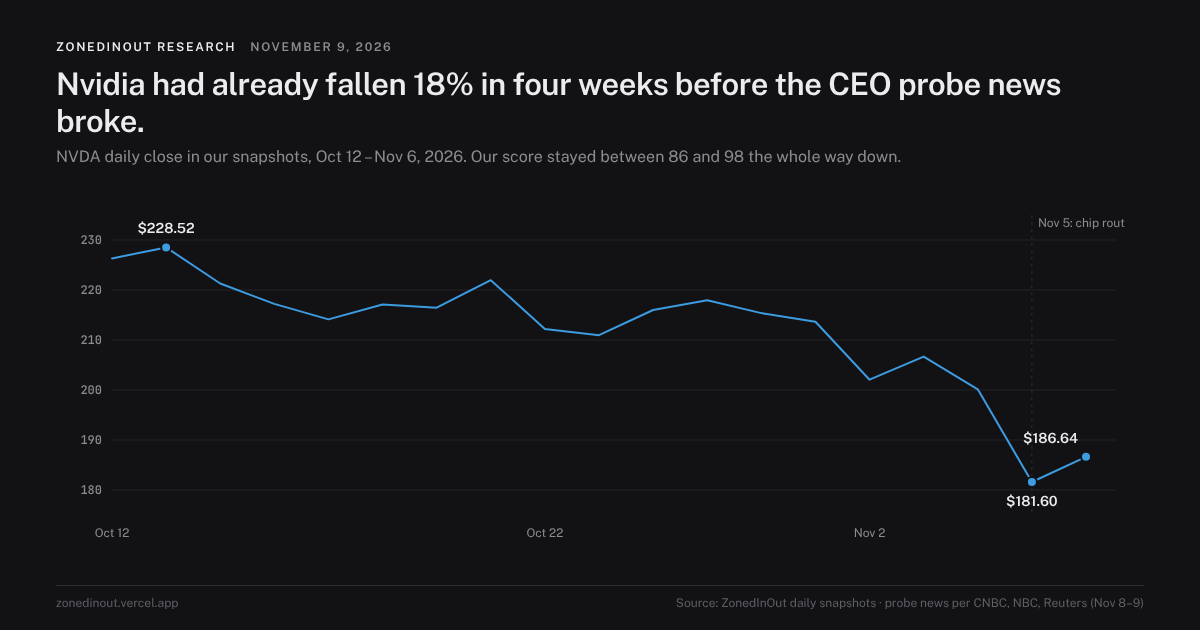
This didn't hit a calm stock. In our snapshots, Nvidia closed at $228.52 on October 13 and $186.64 on Friday, November 6: down 18% in four weeks, and 22% below its 52-week high of $239.24. Most of that came from the AI-financing worries in our earlier note and the November 5 chip rout, when Nvidia fell 9.3% in a day.
So part of Monday's move is a new story landing on a stock that was already under pressure.
Is it a real problem? Three separate risks
1. Key-person risk. Huang co-founded Nvidia in 1993 and has run it ever since. If he stays, the business impact is small. If he were forced out, it would be a genuine shock. The board is backing him today; Wedbush analyst Dan Ives, quoted in coverage of the story, expects him to stay near-term but flagged a "clear risk" that he could be removed depending on what the investigation finds.
2. National-security and export risk. This is the part that makes it different from an ordinary CEO scandal. The woman's company reportedly bought Nvidia's advanced chips. If Congress or regulators conclude that controls on who buys those chips were weak, the result could be tighter rules on Chinese customers or more scrutiny of Nvidia's sales process. Nobody knows yet. The November 18 briefing is the first place to look.
3. Timing. Earnings on November 17, Congress on November 18, an open investigation, and a stock already in a downtrend. Uncertainty tends to keep buyers away until it clears.
What history says, and where it stops
CEOs leaving over personal relationships usually moves a stock less than people expect, because the business doesn't change. When Intel's Brian Krzanich resigned in 2018 over a relationship that broke company policy, and when McDonald's removed Steve Easterbrook in 2019, both stocks fell only about 2–3% on the news.
Those cases aren't a clean match. Neither involved an espionage allegation, a buyer of controlled technology, or Congress. There is no good precedent for this one, which is exactly why the market is cautious.
News versus hype
Hype: "Nvidia is finished." Its biggest customers still plan to spend roughly $725 billion on AI this year, and Amazon has said 2027 will be "meaningfully more." A board investigation doesn't change those orders.
Real: a governance overhang with no end date, on a stock that was already falling and in a market already nervous about AI spending. That can weigh on the price for weeks even if the investigation finds nothing.
Is it over for Nvidia? Nothing known today says so. What's known today says the next two weeks carry more uncertainty than usual.
What our model says, and why we'd be careful with it
Our score has rated Nvidia between 86 and 98 every single day since October 12, while the stock fell from about $228 to $187. That's the score doing what it's built to do: flag a price far below its recent average. It's not a timing signal, and our own audit found that Strong Buys right after a sharp drop have been early this autumn. The score knows nothing about board investigations.
What to watch
- The board's findings, and whether any timeline is given.
- November 17 earnings: guidance for next year matters more than this quarter.
- The November 18 briefing, and any talk of export controls or China sales.
- Whether other chip stocks fall with Nvidia. If they do, it's the AI trade. If only Nvidia falls, it's the probe.
Not investment advice. Facts as reported by the linked outlets as of the morning of Nov 9, 2026; prices from ZonedInOut snapshots.
Scores in this piece come from the ZonedInOut model. How the score works →
Frequently asked
Why is Nvidia stock falling on November 9, 2026?
Is Jensen Huang stepping down?
Are other chip stocks falling with Nvidia?
Is it over for Nvidia stock?
How have stocks reacted to past CEO scandals?
Get the Sunday Brief
One email a week, before the open: what the board did, which calls worked, which didn't, and what changed. Free. No spam, unsubscribe anytime.