Staples, Health Care and Banks Hit 52-Week Highs. Chips Are Now 33% Below Theirs.
Updated November 6 with the November 5 close and the October jobs report.
The Nasdaq is in a correction, yet on November 4 the Dow had its best post-midterm day in 44 years. That isn't money leaving stocks. It's money changing seats.
The scoreboard
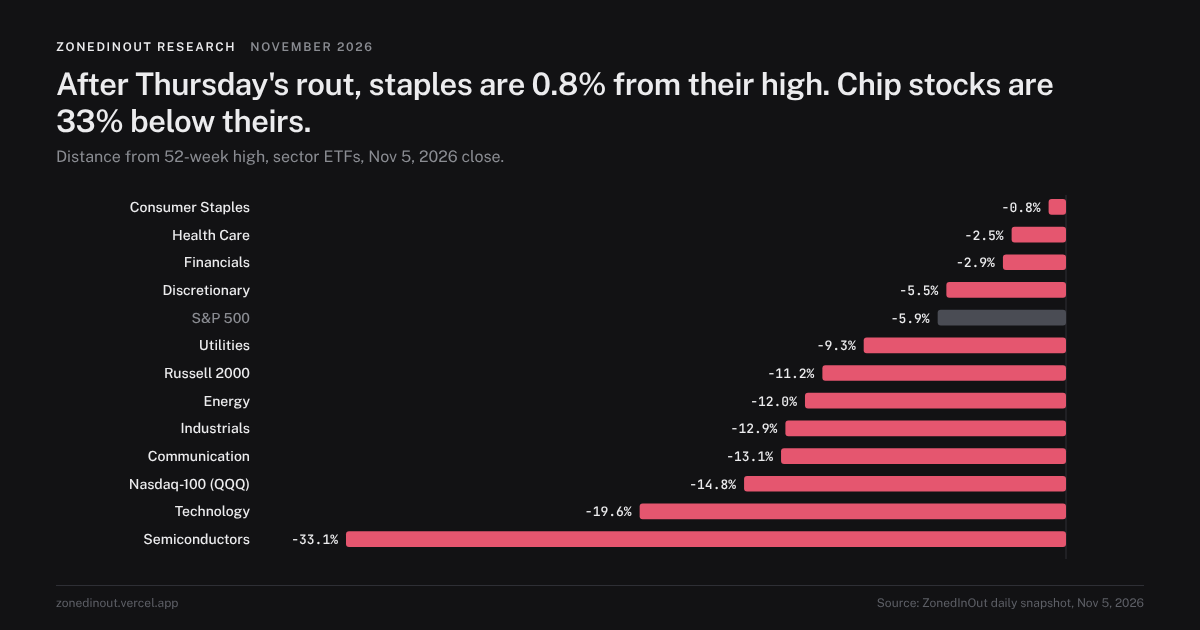
On November 4, consumer staples (XLP), health care (XLV) and financials (XLF) all closed at 52-week highs while the semiconductor ETF sat 25% below its own. Then came November 5, when the S&P 500 fell 4.36%. Here is where everything stood after that close (our snapshot):
| Sector ETF | From 52-week high | Nov 5 move | Last 20 sessions |
|---|---|---|---|
| Consumer Staples (XLP) | −0.8% | −0.75% | +9.4% |
| Health Care (XLV) | −2.5% | −2.5% | +8.3% |
| Financials (XLF) | −2.9% | −2.9% | +5.1% |
| Consumer Discretionary (XLY) | −5.5% | −3.8% | +4.2% |
| S&P 500 (SPY) | −5.9% | −4.4% | −5.9% |
| Utilities (XLU) | −9.3% | −0.7% | +4.6% |
| Russell 2000 (IWM) | −11.2% | −2.9% | |
| Energy (XLE) | −12.0% | −3.0% | −5.3% |
| Industrials (XLI) | −12.9% | −4.1% | −4.0% |
| Communication (XLC) | −13.1% | −0.6% | −5.5% |
| Nasdaq-100 (QQQ) | −14.8% | −13.9% | |
| Technology (XLK) | −19.6% | −8.0% | −18.3% |
| Semiconductors (SMH) | −33.1% | −25.8% |
On the worst day for the S&P 500 since April 2025, staples, utilities and communication each fell less than 1%. Tech fell 8%. Consumer staples are up about 17% this year and hit records on both October 30 and November 4 (CNBC, StockTitan).
Why this matters more than the index
In October the Nasdaq fell 5.3%, its worst month since March 2025. The S&P 500 lost only 0.9%, and the Dow rose 1.7% (Yahoo Finance). A seven-point gap between the Dow and the Nasdaq in one month is a rotation, not a crash.
On November 4, after the midterms:
- Health insurers and hospitals jumped: Centene +12.6%, HCA +10.3%.
- Apple rose 5.3% to a record. Amazon rose about 6%.
- The Dow gained 1,569 points (+3.03%), its best day since April 2025 (CNN).
- AI data-center builders fell 13–23% on moratorium talk.
The odd one out: energy
Energy is 12% off its high even though Chevron and Exxon set records on October 30. Oil explains it. WTI peaked near $110 on October 19 during the Iran war, then fell 8.3% to $88.12 on November 4 on peace-talk headlines and the election result. Energy stocks went from leader to laggard within a week.
What it tells us
Defensives at records while semis break their 200-day averages is what late-cycle de-risking looks like. Investors are paying up for steady cash flow (toothpaste, insulin, bank deposits) and selling capital-hungry growth. Consumer sentiment near record lows (UMich 48.0) fits the same picture.
It isn't a signal to sell everything, even after November 5. Rotations like this can run for months while the S&P 500 goes sideways. It does mean the old leaders may not lead the next leg.
On our board
Our score is built around pullbacks, so names at 52-week highs rarely score high. On November 4, Microsoft scored 66 (Hold) and Apple 80, while beaten-down chip names scored 94–98. Those chip names then fell another 9–18% on November 5. A low score on a staples or health-care name now means "extended," not "bad." A high score on a chip name means "far below average," not "safe." Read both with the rotation in mind.
Data: ZonedInOut snapshots of Nov 4 and Nov 5, 2026, plus linked sources. Not investment advice.
Scores in this piece come from the ZonedInOut model. How the score works →
Frequently asked
Which sectors are at 52-week highs in November 2026?
Is there a sector rotation out of tech?
Why did the Dow jump after the 2026 midterms?
Get the Sunday Brief
One email a week, before the open: what the board did, which calls worked, which didn't, and what changed. Free. No spam, unsubscribe anytime.