Our Score Says Strong Buy on AMD, Micron and Palantir. Our Own Archive Says Be Patient.
Updated November 6 with the November 5 close and the October jobs report.
On November 4 our board was full of AI names scored 98: AMD, Micron, Palantir, Cloudflare, Snowflake, Dell. That's what our score is built to do. It rewards stocks that have pulled back hard below their 20-day average.
So we checked how that exact setup has worked in our own archive, and the answer isn't flattering. The next day made the point for us (see the update below).
The test
We took every daily snapshot from June 29 to November 5, 2026 and picked out stocks that were:
- scored 90 or higher (Strong Buy), and
- down 10% or more over the previous 5 sessions.
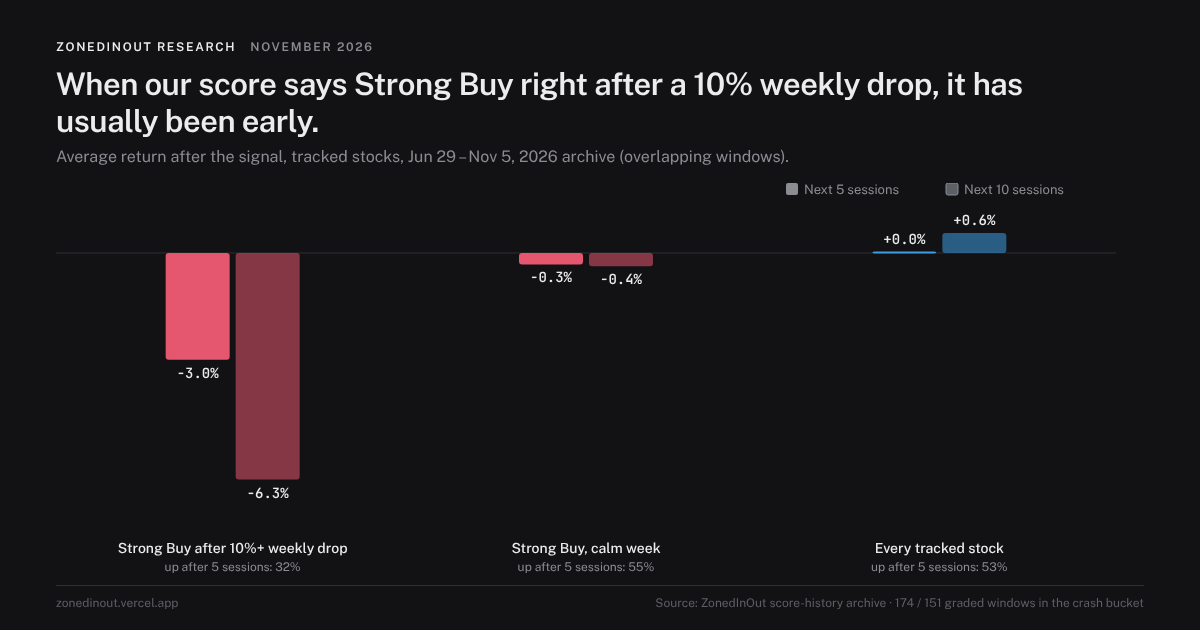
Then we checked what each one did over the next 5 and 10 sessions, and compared it with two groups: Strong Buys after a calmer week (down less than 5%), and every stock we track.
| Group | Next 5 sessions | Up after 5 | Next 10 sessions | Windows graded |
|---|---|---|---|---|
| Strong Buy after a 10%+ weekly drop | −2.99% | 32% | −6.35% | 174 / 151 |
| Strong Buy, calm week | −0.32% | 55% | −0.37% | 424 / 218 |
| Every tracked stock | +0.04% | 53% | +0.56% | 6,689 / 5,184 |
Against SPY over the same 5-session windows, the crash bucket trailed by 2.59 points on average. Since November 5, even Strong Buys after a calm week are slightly negative on average.
Now the important caveat
Almost all of those crash-bucket readings are from this autumn:
| Period | Windows | Avg next 5 sessions | Up after 5 |
|---|---|---|---|
| Jun 29 – Aug 21 | 17 | +6.87% | 65% |
| Oct 12 – Nov 5 | 157 | −4.05% | 29% |
In the summer, the few stocks that got a Strong Buy after a sharp drop bounced well. Since October, falling stocks have kept falling. That matches what we found in October's score tiers, where our highest scores did the worst.
So the fair conclusion isn't "the signal is broken." It's narrower: in a market that rewards momentum, a Strong Buy right after a crash has been early, often by more than a week. Seventeen summer windows is far too few to say the bounce pattern will come back on schedule.
Update: what those 22 stocks did the very next day
At the November 4 close, 22 stocks were scored 90+ after a 10%+ five-session drop: AMD, Micron, Palantir, Cloudflare, Snowflake, Cerebras, Dell, Elastic, Twilio, Intel, Natera, Arm, ASML, Applied Materials, Lam Research, SanDisk, Lumentum, Marvell, Datadog, Super Micro, CoreWeave, Reddit.
On November 5, all 22 fell. They lost 11.8% on average, against −4.4% for SPY and −5.5% for the average stock we track.
| Biggest one-day drops | Nov 5 |
|---|---|
| SanDisk | −22.3% |
| Lumentum | −18.7% |
| Micron | −17.5% |
| AMD | −17.3% |
| Marvell | −16.4% |
| Lam Research | −16.4% |
| Dell | −14.9% |
The mildest was Twilio at −5.9%. One day proves nothing about the long run, and some of these may well be higher in a few months. But it's exactly the pattern the table above describes, and we said so the day before. After the drop, 38 stocks now sit in the same bucket.
Most of them are AI hardware or AI software, the exact group the market is repricing right now (why).
How we'd use this
- A Strong Buy is a level, not a timing call. Our score says the price is far below its recent average. It doesn't know about Alphabet's cash flow or CoreWeave's credit spreads.
- Wait for the falling to stop. In this tape, a name that holds its low for a few sessions has done better in our data than one bought on the way down. The falling-knife flag on the Rankings page exists for this reason.
- Size smaller. If you buy a 98 that just dropped 14% in a week, assume the next week can look the same.
- Check our Receipts. We log every Strong Buy and grade it later, wins and losses alike.
Data: ZonedInOut score-history archive, Jun 29 – Nov 5, 2026, with a gap from Aug 22 to Oct 11. Windows overlap, so they aren't independent samples. Not investment advice.
Scores in this piece come from the ZonedInOut model. How the score works →
Frequently asked
Is AMD a buy after the November 2026 selloff?
Does buying the dip work in a correction?
Why does ZonedInOut show Strong Buy on falling stocks?
Get the Sunday Brief
One email a week, before the open: what the board did, which calls worked, which didn't, and what changed. Free. No spam, unsubscribe anytime.