Our Model Gives Bonus Points to Quiet Sell-Offs. In Both Regimes We've Recorded, the Loud Ones Did Better.
One of the five layers in our score (Layer 4, about 5% of the signal) adds up to 2 points when a stock falls on light volume. The idea is that quiet selling means weak conviction, so the dip should be easier to buy. We tested that against our own snapshots. Volume ratio (today's volume divided by the 20-day average) has been recorded since July 31.
One difference from the live rule: our test groups Buy Zone names by volume on the snapshot day, whether that day was up or down. The model's rule only applies on down days. That makes this an adjacent test, not an exact replay.
The result
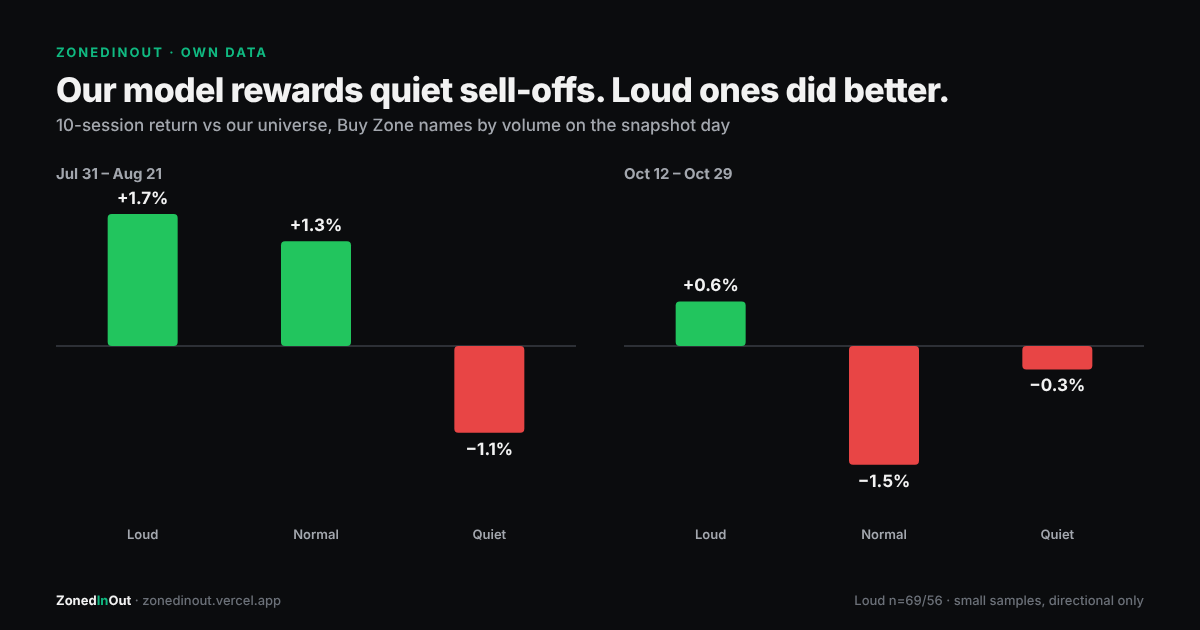
Average 10-session return of Buy Zone names (score 79+), measured against the average of our whole universe over the same window:
| Volume on snapshot day | Jul 31 – Aug 21 | n | Oct 12 – Oct 29 | n |
|---|---|---|---|---|
| Loud (1.5× average or more) | +1.69% | 69 | +0.57% | 56 |
| Normal (0.8× to 1.5×) | +1.34% | 344 | −1.52% | 306 |
| Quiet (under 0.8×) | −1.11% | 174 | −0.30% | 196 |
In both periods, the loud group did best against the universe over 10 sessions. In August, quiet was the worst group. In October, normal-volume names were the worst, and quiet was in the middle.
The honest caveats
- The loud groups are tiny: 69 and 56 overlapping windows.
- 5 sessions tells a different story in October: quiet names did slightly better than loud ones (−0.16% against −0.54% relative to the universe). Only the 10-session result is consistent.
- The layer is small. At ±2 points out of a 30–98 range, flipping it would move a few names across a tier line and nothing more.
Why loud might beat quiet
The textbook view is that heavy volume on a drop means institutions are selling, so stay away. The other reading is capitulation: a high-volume flush clears out sellers, and the bounce starts from a cleaner base. A quiet drift lower can just mean nobody has bothered to buy yet. Our data leans toward the second reading, weakly.
What we're doing
Nothing to the live score yet. A 5% layer, two short windows, and an inconsistent 5-session result don't justify a change. This test is now on the list we re-run monthly. If loud keeps beating quiet through November and December, we'll reverse the bonus and say so here.
Full model breakdown: methodology.
Scores in this piece come from the ZonedInOut model. How the score works →
Frequently asked
Is a high-volume sell-off a bad sign for buying the dip?
Does ZonedInOut's score reward low-volume pullbacks?
Will ZonedInOut change the volume layer?
Get the Sunday Brief
One email a week, before the open: what the board did, which calls worked, which didn't, and what changed. Free. No spam, unsubscribe anytime.