Should You Buy Stocks That Are Down 50%? What Our Data Says About Deep Dips
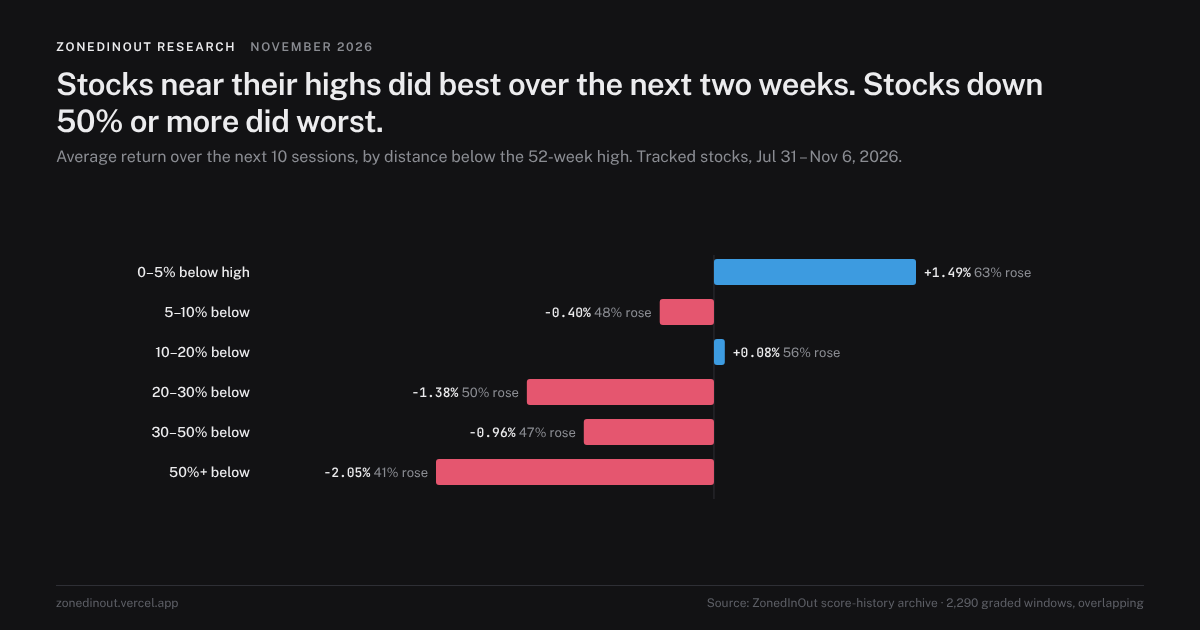
"Buy when it's down 50%" sounds like common sense. In our own data this autumn, it was the worst place to be.
The test
We took every daily snapshot of the stocks we track from July 31 to November 6, 2026, sorted each stock by how far it sat below its own 52-week high, and checked what it did over the next 10 trading sessions.
| Distance below 52-week high | Avg next 10 sessions | Share that rose | Windows |
|---|---|---|---|
| 0–5% (near the high) | +1.49% | 63% | 374 |
| 5–10% | −0.40% | 48% | 293 |
| 10–20% | +0.08% | 56% | 475 |
| 20–30% | −1.38% | 50% | 354 |
| 30–50% | −0.96% | 47% | 504 |
| 50% or more | −2.05% | 41% | 290 |
Over 5 sessions the shape was similar: the 50%+ group averaged −1.46% with 44% rising, the weakest of all six groups.
What it shows
- Stocks near their highs did best. That's momentum: in this market, strength kept being rewarded.
- The deepest holes kept getting deeper. A stock down 50% wasn't "cheap" in the sense of about to bounce. More often it was still being sold.
- The middle was noisy. The 10–20% group did a little better than the 5–10% group, so this isn't a smooth line. The clear findings are at the two ends.
Why this might be happening
Stocks that have halved usually have a reason: a broken growth story, a balance-sheet problem, a sector being repriced. This autumn that sector was AI hardware and infrastructure, with names like Lumentum, Marvell and Intel down roughly 50% in 20 sessions (why). Sellers in that kind of repricing tend to keep coming for a while.
Honest caveats
- Short window. About three months of data, with a gap from August 22 to October 11, during a market that favored momentum. In a different market the bounce pattern could come back.
- Our list, not the whole market. Our tracked stocks lean toward growth and tech.
- Overlapping windows. Consecutive days share most of the same future, so these aren't independent samples.
How to use it
- Before buying a stock down 50%, ask why it's down and whether that has changed. "It's cheap" isn't a reason.
- Wait for it to stop falling. A name that holds its low for a few sessions is a different setup from one still sliding.
- If you want exposure to a beaten-down sector, a broad fund spreads the risk that any single name keeps falling.
Every tracked stock has its own page with its live score and distance from its high, for example NVDA or AMD.
Data: ZonedInOut score-history archive (data/score-history.json). Not investment advice.
Scores in this piece come from the ZonedInOut model. How the score works →
Frequently asked
Is it a good idea to buy stocks that are down 50%?
Does buying the dip work?
How do I know if a falling stock has bottomed?
Get the Sunday Brief
One email a week, before the open: what the board did, which calls worked, which didn't, and what changed. Free. No spam, unsubscribe anytime.